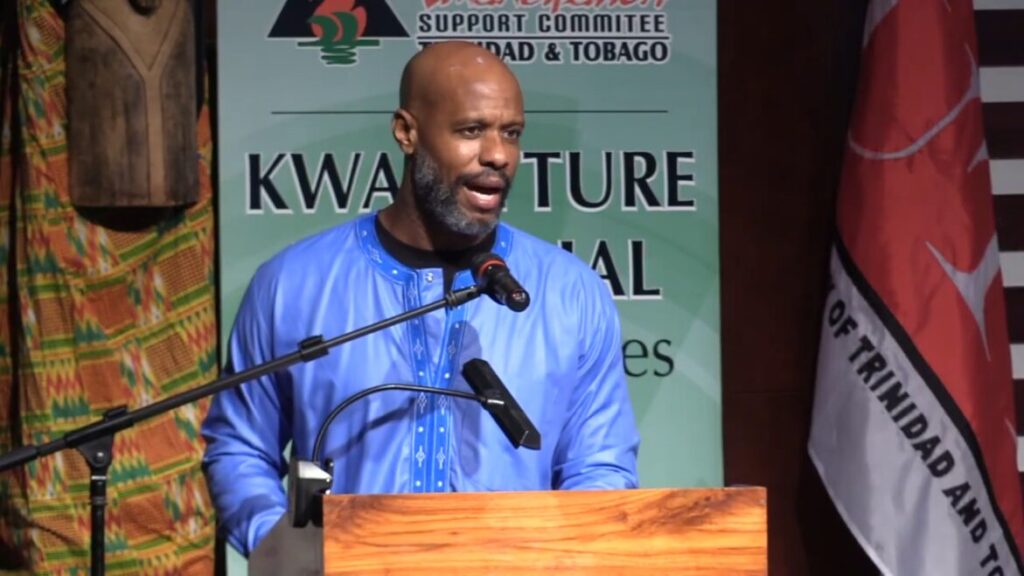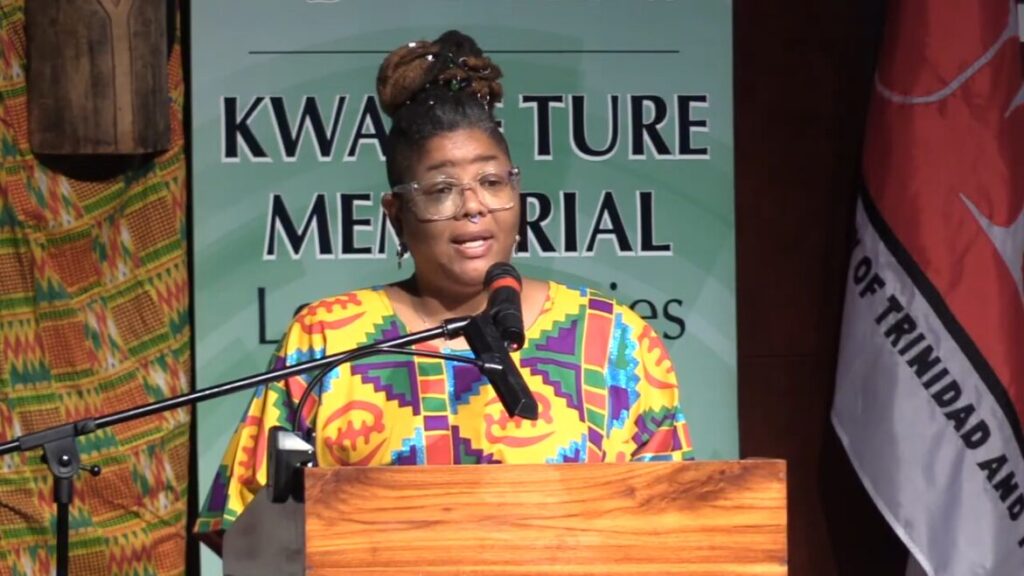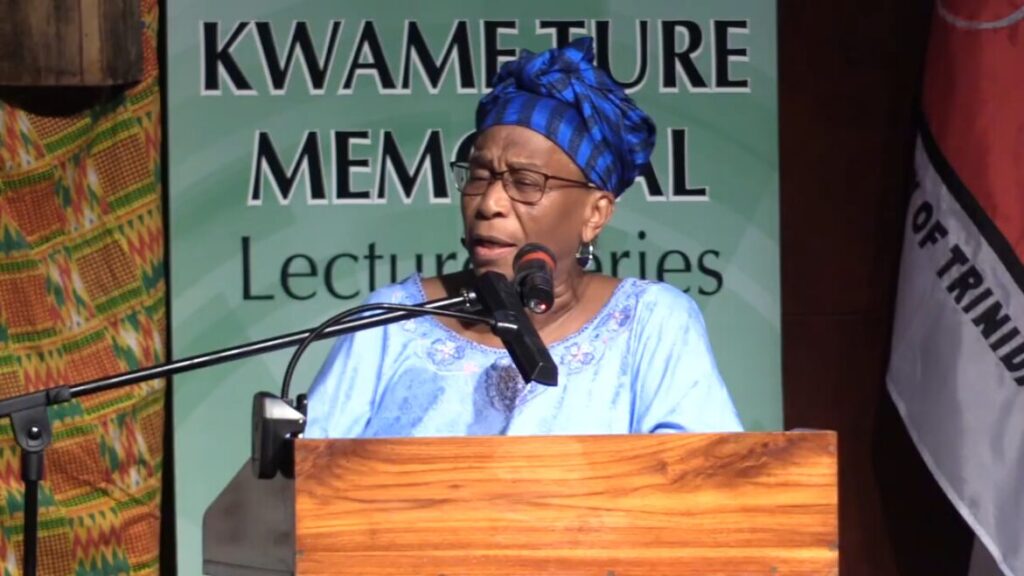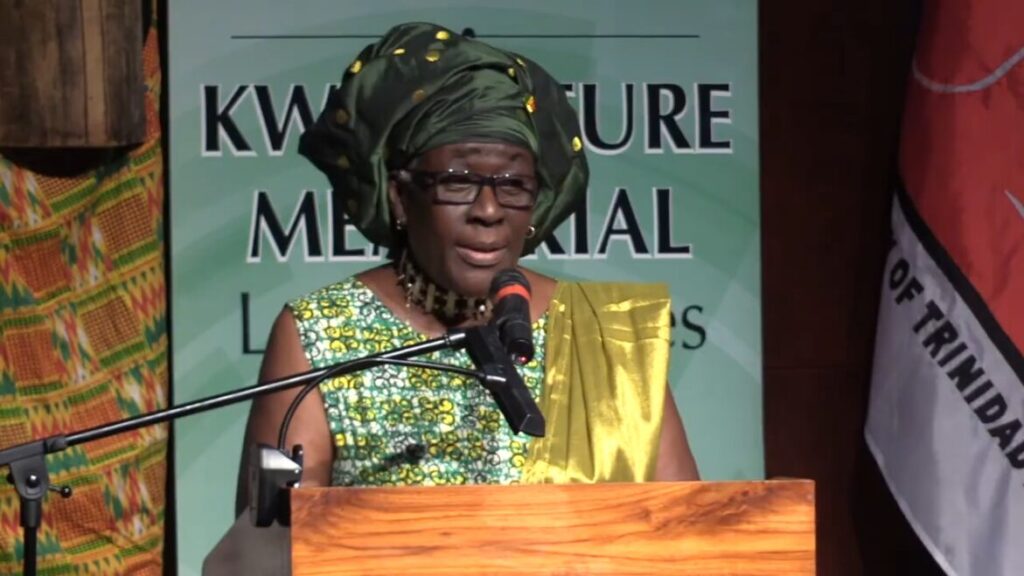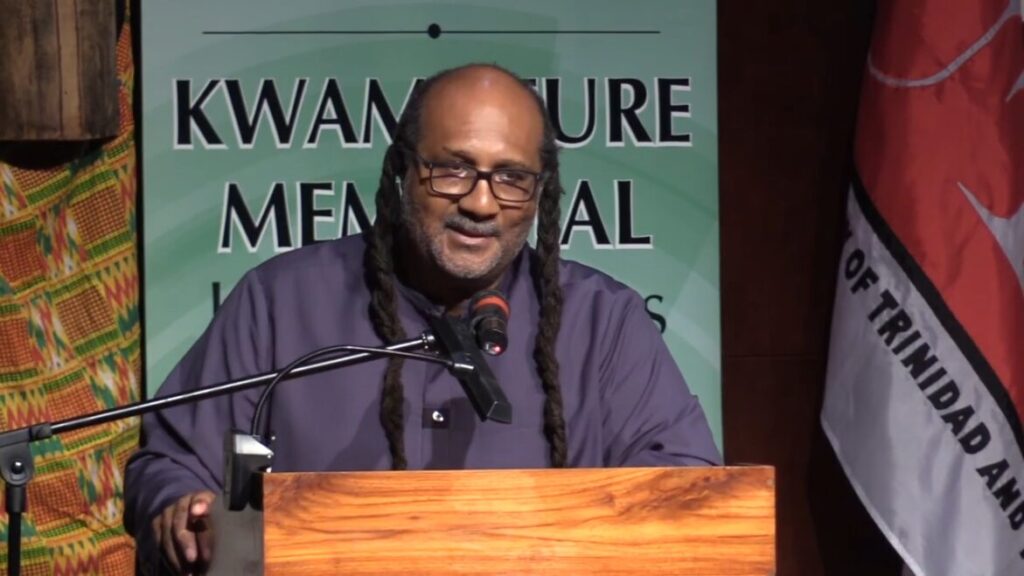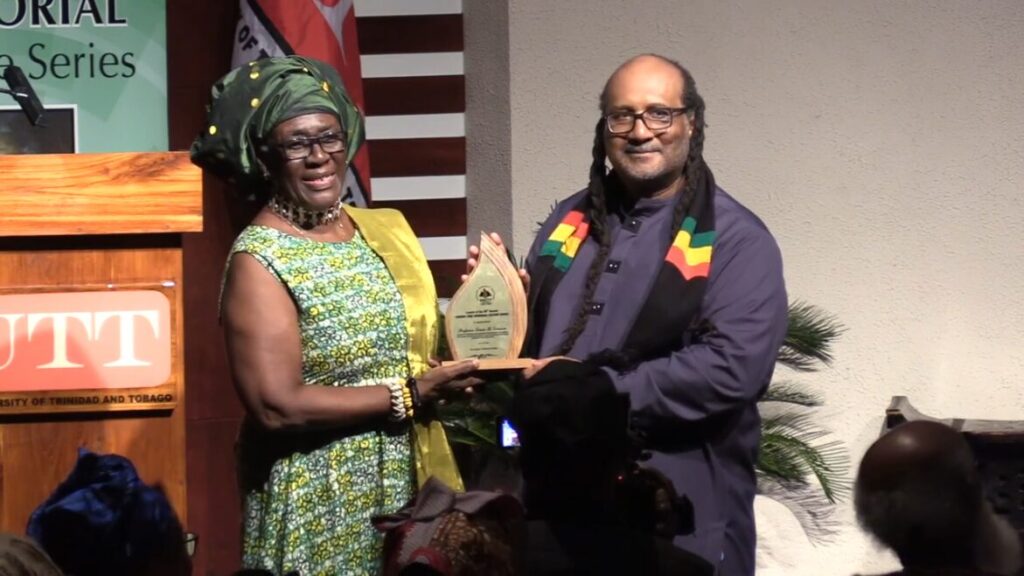

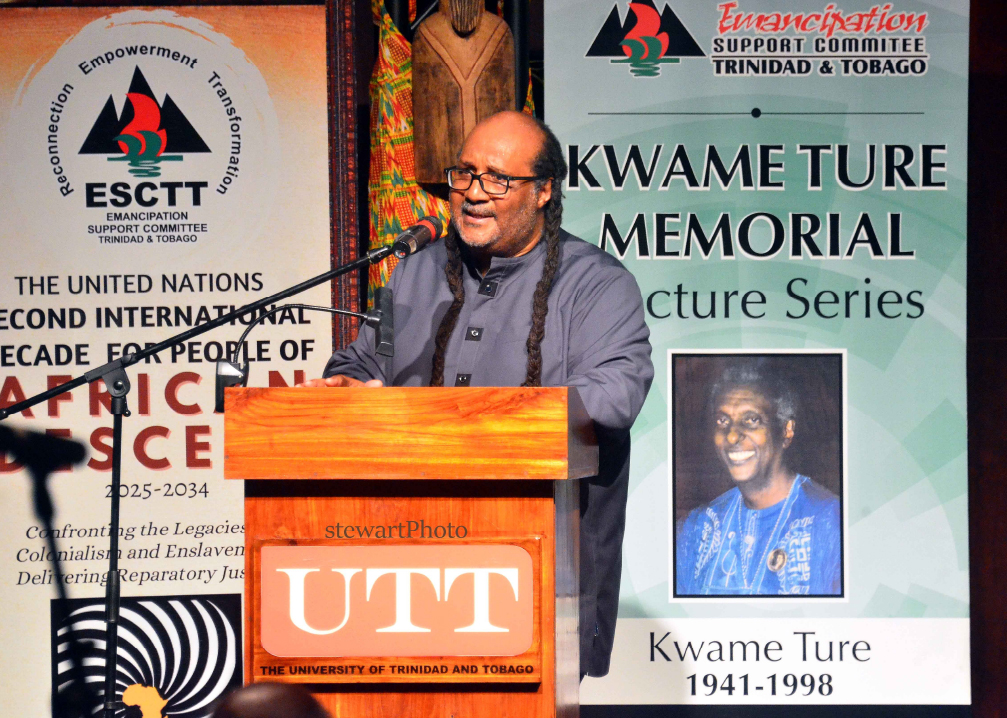
World-renowned Frantz Fanon Scholar, Board of Trustees Distinguished Professor, and Global Affairs and Philosophy Department Head at University of Connecticut, Dr. Lewis Gordon, under the auspices of the Emancipation Support Committee of Trinidad and Tobago (ESCTT), gave the feature address at the launch of the 26th Annual Kwame Ture Memorial Lecture Series (KTMLS).
The event was held at University of Trinidad and Tobago (UTT) Port of Spain Campus, NAPA, on June 15th, 2025, in recognition of the civil rights giant, Kwame Ture. The ESCTT chose to shine the spotlight on Frantz Fanon during this year, the centennial of his birth
Relevance
Working Towards ’Black Power’
Professor Gordon asked the audience to consider Fanon’s distinction between “liberation and freedom”. Freedom, according to Gordon, can be understood as a combination of economic and social development, together with peoples’ empowerment. He argued that independence had brought liberation to our region, but not freedom. In spite of the global engagement with Black cultural expressions, “Black Power” has not yet been achieved since the institutions of power – “governance, religion, education systems and architecture” – are still colonised.
Challenging the Caribbean Nation State
He reminded us that Fanon was “anti-nation-state, and that nation states produce notions of insiders and outsiders.” He continued, “vulnerable people want to be able to move where opportunities are. Nation states block movement.” Gordon made the point that within the Caribbean region, the notion of insular states that block the free movement of people still exists. To compound the hardship, travel through the United States is often necessary to get from one island to another.
Innovation Over Mimicry
Gordon noted that Fanon decried mimicry. Within modern Caribbean societies, we often adhere to systems that were devised under different cultural and environmental constraints. As we seek to advance sustainable societies that are prepared to successfully participate in the global economy, it is essential that we eschew the mimicry of the global north and become bold with our innovation of ideas and technologies.
Decolonising the Mind
Racism
Gordon offered an interpretation of Fanon’s seminal work “Black Skin, White Mask,” which he described as a double lie. The lie of the “White Mask” is that white people are inherently superior to all others. The lie of “Black Skin” is that it is a marker of inferiorit
“Racism is about constructing a world where there are ‘selves’ and ‘others’” and furthermore, where “there are people in the world who are not others.
He used the example of the genocide happening in the Sudan to illustrate the complete lack of accountability for what happens to people who are not considered even “an other.” The undervaluing of the lives of the Sudanese people is a direct result of the racist dehumanization of Black people that began in the colonial period.
Gordon addressed violence, a key theme in “The Wretched of the Earth,” with a reminder of the extent of white violence that has occurred over the last five hundred years. The professor called upon the audience to observe one of the direct results of this violence – the limited representation of the indigenous people of the Caribbean in the lecture hall. Despite historical records and evidence in front of our eyes, people are led to believe that they are “safer in the world if it is run by whites.”
Professor Gordon asserted that Fanon was actually anti-violence but subscribed to the belief that it is better to intervene and be called violent than to stand on the side and be silent. If you were going to intervene, Fanon believed that you should do so for results that “will build a better, healthy, and just society.”
Nationalism
According to Gordon, Fanon would warn against the pitfalls of uncritical nationalism, particularly the potential for newly independent nations to replicate colonial power structures under a nationalist banner. He reminded us that, “Some people call themselves left, but they are on the right. Right wing-ism has very clear objectives – it looks for order, wants to eliminate differences; its objective is to become one, homogenous. The historic left, on the other hand, was premised on a set of values: Humanism, equality, dignity, no one is above the law, joy, flourishing, growth. When you fetishize the one-size-fits-all, even if you are on the left…you may call yourself left but you are really on the right.”
Colonialism
Colonialism uses apartheid, the separation of groups, to reinforce social hierarchies. As part of decolonisation, we have to understand this logic and dismantle it.
Director of the Caribbean Freedom Project and moderator, Shabaka Kambon, posed the question to the professor: “During your presentation you suggested that those who called what was taking place before Oct 7th genocide, were empirically incorrect. But
could you not use the logic of Fanon to support that statement, since he argued that the logic of colonialism was genocide?”
Professor Gordon replied, “Fanon actually argues that the logic of colonialism is apartheid, to create separation. In the US, as an example, they had separation. When they began talking of genocide it was because they could no longer use the people…when you were no longer necessary for that system”. He went on to elaborate, “When the attack occurred on October 7th, those who would say that the aspiration of Likud was genocidal were absolutely correct. Because their logic was ultimately the question of expansion and that meant Palestinian people were in the way of expansion.” Dr Gordon said that with regard to the escalation of the genocide taking place in Gaza, “it is clear that Trump and the US see the Gaza, West Bank, Palestine as real estate. That is classic dehumanisation…the Likud sees it as an opportunity for de facto genocide. There was an opportunity to do something different. It is pretty clear that the project – their project – is on the wiping out of the people”.
The Black Power Revolution and the KTMLS
The ESCTT created the KTMLS to increase public discourse pertaining to the ongoing process of Emancipation. The foundation for this discourse emerged from the rupture in colonial thinking as a result of the Black Power Revolution of the 1970s and 80’s in the Caribbean. ESCTT Board Member, Dr. Asha Kambon, noted that, in Trinidad and Tobago, this movement sought to remove the vestiges of Colonialism; fulfil the promise of independence; and bring real Power to the People. Its realisation must result in transformed power structures in which the country and its resources are managed for the benefit of all. There must be transformed governance, economic, social and cultural processes
Criticism of the lecture included the argument that anti-Zionism is at the core of Ture’s view on Pan Africanism, and therefore a more strident anti-Zionist view should be presented at any lecture in his name. Although we agree that Ture held a strong stand against Zionism, we at the ESCTT disagree with the notion that this was at the core of his belief. Any clear reading of Kwame Ture’s body of work will reveal that the principles of social and racial justice; anti- imperialism, self-determination; and equality for African people and all people living under the yoke of oppression and colonialism, are at the core of Kwame Ture’s Pan Africanist philosophy.
Contrary to misinformation circulated after the lecture, there was no curfew declared by the newly installed government of Trinidad and Tobago in 2025. The last curfew was in effect in 2011.
Dr. Kela Francis, representing the President (Ag) of the University of Trinidad and Tobago, Dr. Stephen Joseph, reminded the gathering that “social transformation in a former colony through education requires at least two difficult things: ensuring access to education and dismantling the grand narratives of colonial hegemony that underpin our notions of progress and development.” She thanked the ESCTT for organizing events such as the KTMLS, noting that “in a world increasingly focussed on optics rather than on substance, the temptation is to reduce Emancipation to a one day dress-up, however by continuing to host events like the KTMLS the ESCTT is doing its part to promote the deeper, more complicated and sometimes uncomfortable meaning of Emancipation”.
The Executive Chair of the ESCTT, Zakiya Uzoma Wadada, thanked the audience for supporting the KTMLS; UTT for partnering with the ESCTT; and especially our guest lecturer, Professor Lewis R. Gordon, for journeying from afar to join us.
The room went electric with the words of Brother Ronaldo Mohammed, a spoken word poet who delivered his piece, “Decolonise My Language”:
“I am the Wretched of the earth, the Fanon fanning the flames, I am the root, like meh locks resolute…I is the language still surviving.”
We invite you to listen to the full lecture available on the ESCTT YouTube channel and website: www.emancipationtt.com